
A decorative perfume cap contributes to appearance and handling, but its material does not by itself establish the bottle’s seal. Compare the outer shell, inner insert, pump and functional sealing parts separately, then evaluate the complete assembly and quotation.
Common Perfume Cap Materials
Each material brings a unique combination of weight, surface finish, and processing method. Here’s a quick overview of what buyers typically encounter:
- Zamak, aluminum, brass or copper: Review the exact alloy, geometry, finish, measured weight and inner fitment. Do not infer cost, grade or delivery from the material alone.
- Ionomer, PMMA or ABS: Identify supplier grade, tooling and decoration, then compare actual appearance and mechanical-test evidence. A resin name is not a performance rating.
- Wood: Define species, finish, variation reference and inner insert. Verify any sourcing/certification claim for the supplied component.
- Recycled or bio-based material: Verify the grade, content/claim basis and supplier records; assess the actual dimensions, finish and assembly rather than assuming an environmental benefit.
Customization Options That Go Beyond the Material
The material is the starting point. What makes a cap uniquely yours is how you treat its surface, shape, and functional details. Here are the main levers:
Surface Finishes & Decorating Techniques
- Plating or metallization: Confirm the actual process, coating system and supplier specification. Select adhesion, corrosion or exposure tests according to the component and intended use.
- Soft-touch, color or gradient coating: Approve a production-material sample and defined appearance/handling criteria; request quote-specific setup and yield assumptions.
- Engraving, printing or foil: Confirm suitable artwork and allowable detail for the substrate and finish; inspect a decorated sample.
- In-mold or molded detail: Review tooling, registration and material-specific limits. No process name guarantees scratch resistance.
Shape & Dimensional Customization
Review outer geometry and the actual retention mechanism with the supplier. A decorative push-on or magnetic cap may engage a pump collar or insert rather than seal directly to the bottle neck. Identify what holds the cap and what seals the formula; those functions may belong to different parts.
Inserts & Liners
Label four elements on the assembly drawing: decorative outer cap, inner insert/retainer, pump/actuator and functional gasket or other seal. Record exact part and drawing revisions, contact surfaces and tolerances. A nominal diameter or decorative-cap material cannot confirm the pump/bottle seal.
Illustrated component roles
These four original panels separate the decorative outer cap, cap-retention insert or sleeve, pump and actuator, and functional sealing element. They are fictional, non-production-approved concepts, not a matched assembly or fit cross-section. No dimensions, material grade or sealing result is represented.
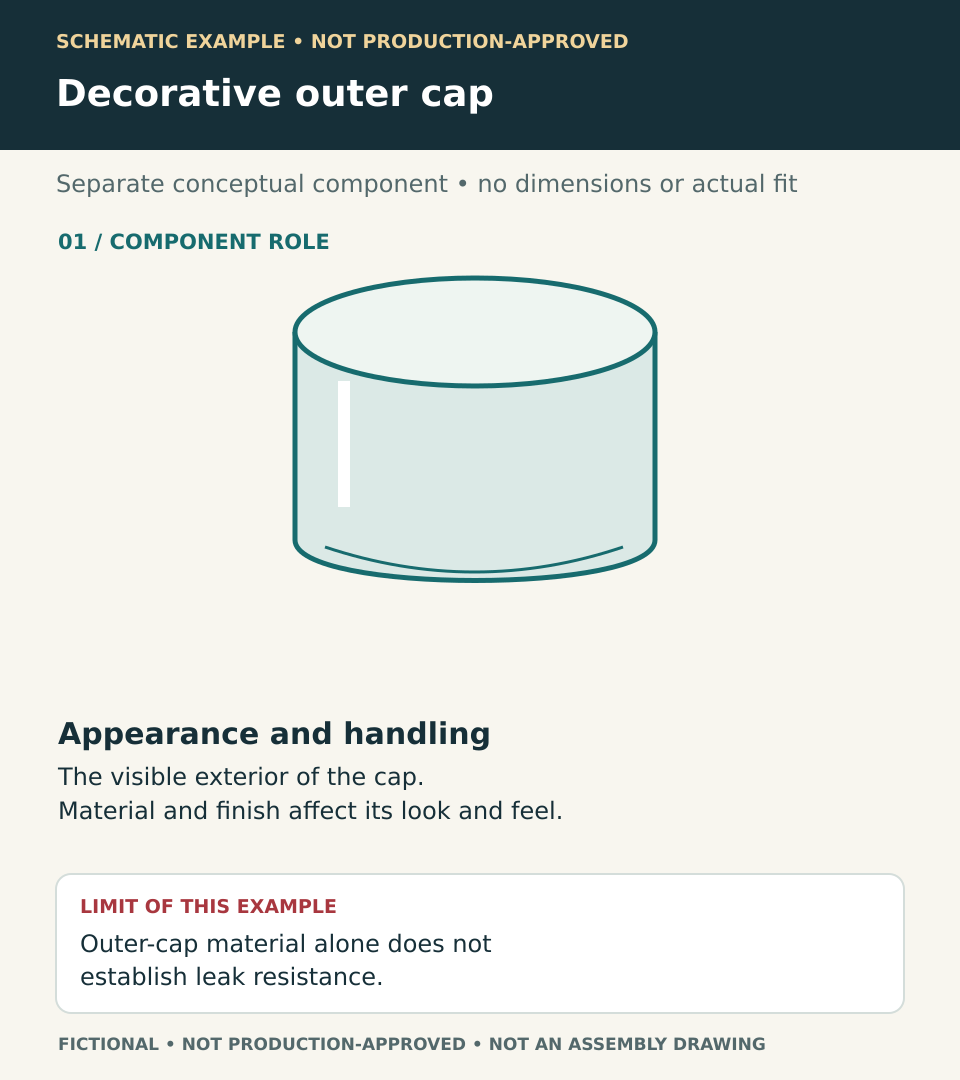
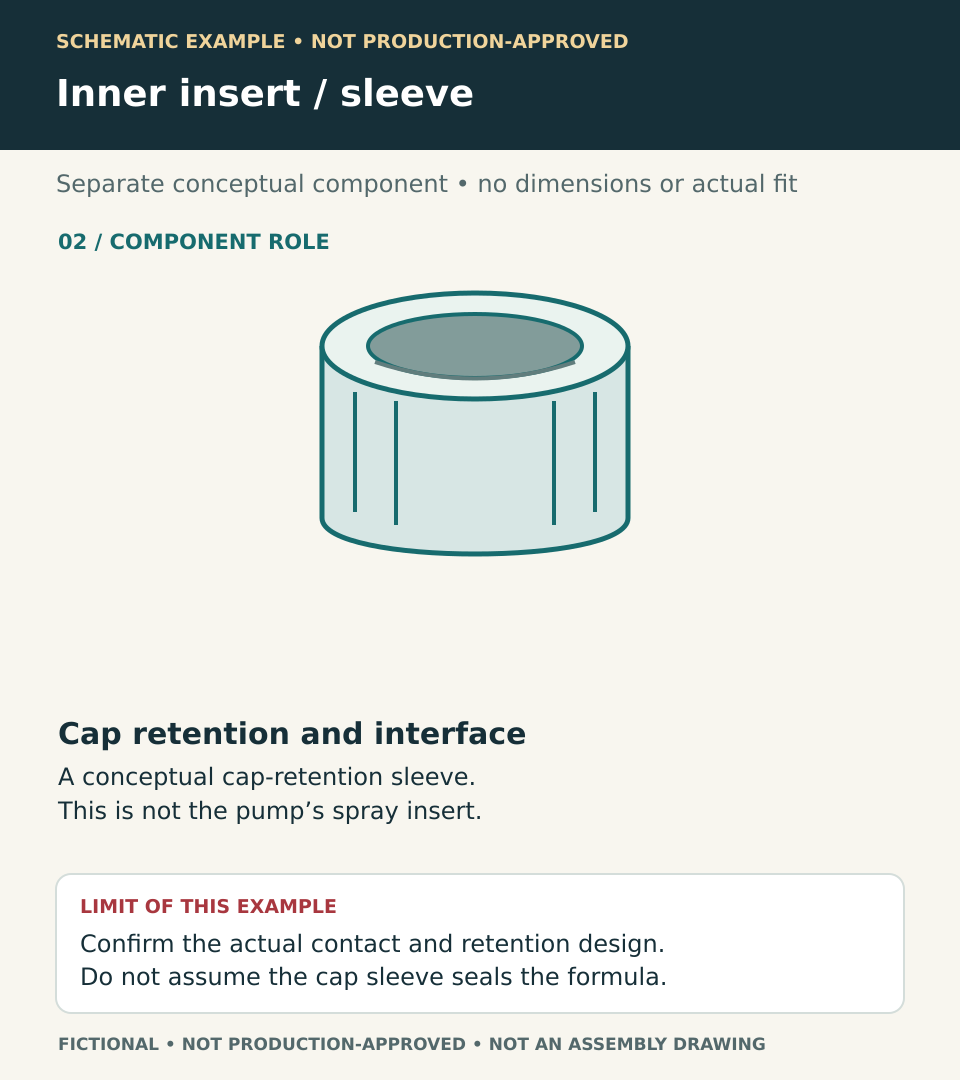
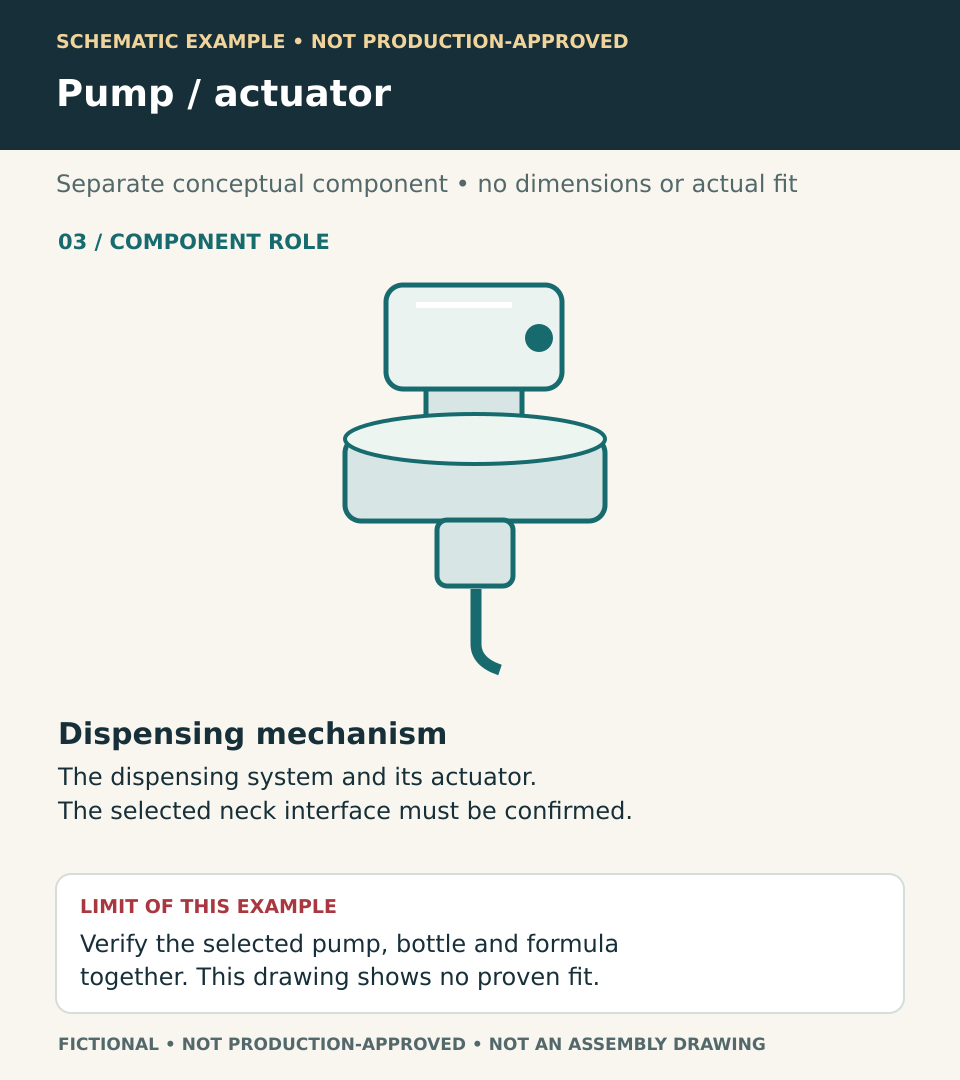
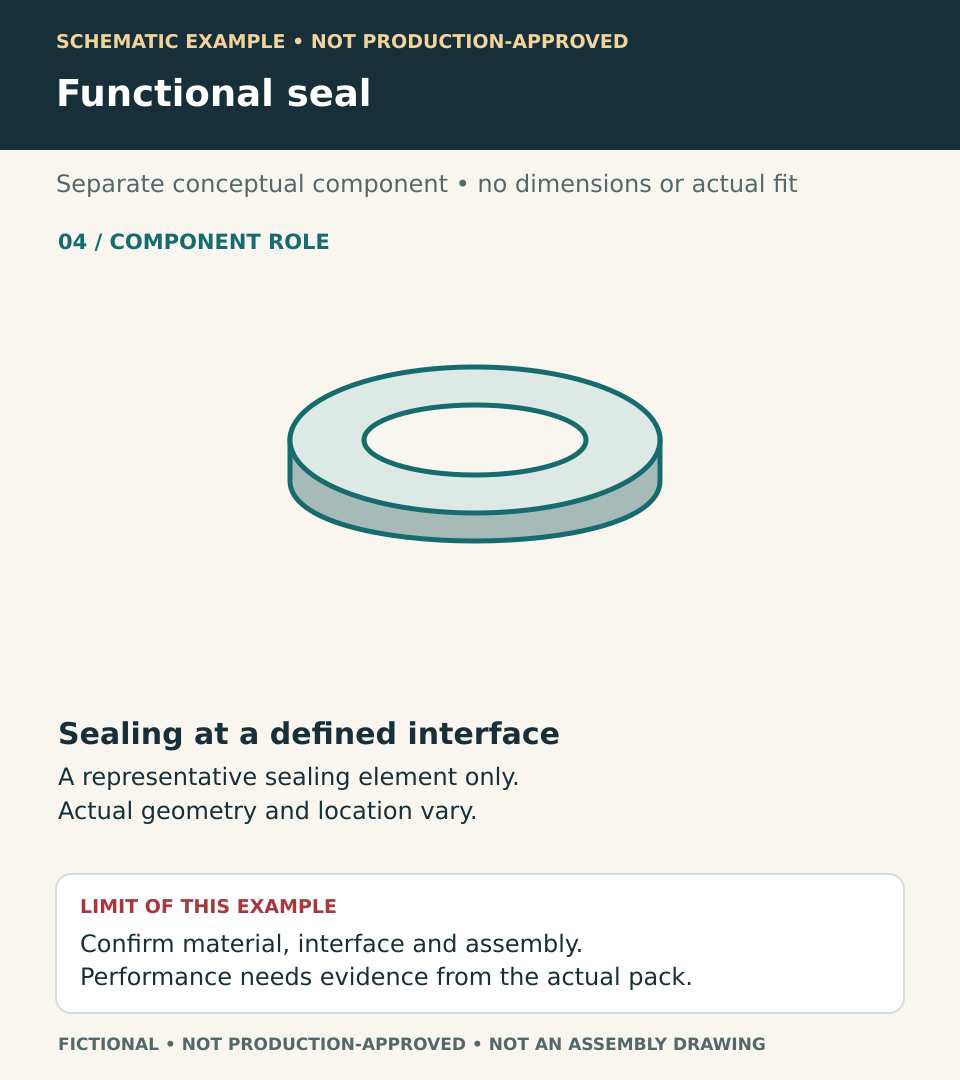
Identify the actual parts, contact interfaces and approved drawing revisions for your package. The inner sleeve shown is a cap-retention concept, not the pump’s spray insert. Decorative-cap material alone cannot establish leak resistance; assess the actual formula and bottle/pump/seal assembly with the agreed methods and acceptance criteria.
What to Ask Before You Approve a Cap Sample
When you receive a prototype or production sample, check these points—and ask for the corresponding documentation:
- Dimensions and fit: Measure the specified interfaces against approved drawings for the actual bottle/pump/cap assembly.
- Retention and assembly: Agree application/removal or pull-off methods, cycle count, sample count and limits.
- Finish/exposure: Select abrasion, adhesion, corrosion or formula-contact methods appropriate to the material and foreseeable exposure, with conditions and acceptance set before testing.
- Handling: Evaluate the assembled package under the agreed route/use conditions rather than a universal drop height.
- Appearance: Agree the physical reference, lighting, measurement method and allowable variation.
| Component option | Project data | Acceptance evidence |
|---|---|---|
| Metal outer cap + insert | Alloy/finish; drawing; measured weight; lot; quote/lead-time basis | Fit/pull-off/appearance reports for actual assembly |
| Resin outer cap + insert | Grade/finish; tooling; drawing; lot; quote | Actual mechanical and relevant exposure tests |
| Wood/composite cap | Material/finish/insert; drawing; variation reference | Fit, appearance and claim evidence as applicable |
Frequently Asked Questions
What is the most affordable cap material for a startup fragrance brand?
Compare quotations for the same design, finish, quantity and tooling scope. There is no universally lowest-cost cap material, and an existing design does not guarantee a particular minimum or delivery date.
Can I customize a cap after it’s been produced if my logo changes?
Ask the decorator whether the revised logo can be applied to the actual finished cap, substrate and coating. For molded or embossed details, confirm whether tooling changes, replacement parts or another approved approach are required. Approve the revised artwork, sample and quotation before proceeding.
Does a metal cap guarantee a premium feel?
Not necessarily. A poorly plated zamak cap with a thin, uneven coating will look cheap and may corrode. The craftsmanship of the finishing is just as important as the base material. Always request a PP (pre-production) sample that has gone through the full finishing line, not just a raw casting.
Are there restrictions on electroplating for certain markets?
Have a qualified reviewer identify which restrictions apply to the component, substance, process and intended exposure in the destination market. Do not apply a generic nickel-release limit to every perfume cap or treat a supplier’s broad REACH statement as proof for the exact article. ECHA’s nickel skin-contact guidance illustrates why the intended contact conditions matter; it does not certify this cap (guidance dated 2014, checked 10 October 2026).
How do I ensure the cap matches my bottle color exactly?
Agree a physical reference on the actual substrate/finish, inspection lighting and color/appearance tolerance. Review a finished assembly; a paper swatch or a named light source alone does not guarantee an exact match.
Assembly evidence to request
| Identification | Conditions and result | Approval |
|---|---|---|
| Bottle/pump/cap/insert/seal IDs and lots [ ]; annotated real drawing/photo [ ] | Dimensions [ ]; fit/pull-off method [ ]; force/cycles [ ]; sample count [ ]; limits/results [ ] | Report [ ]; reviewer [ ]; approved changes/retest [ ] |
| Formula and exposed parts [ ]; coating/grade [ ] | Exposure method [ ]; temperature/time [ ]; observations [ ]; limits/results [ ] | Technical review [ ]; market applicability assessment [ ] |
To discuss the proposed cap, insert, pump and seal structure, Request a Quote and confirm the available drawings, samples and review scope.