
When launching a new perfume line, the bottle you choose does more than hold fragrance—it heavily dictates your minimum order quantity (MOQ) and how fast you can get products to market. Whether you’re a startup brand testing a concept or a growing house planning a seasonal launch, understanding the link between packaging decisions, unit thresholds, and production timelines can prevent costly delays and warehouse overflow.
How packaging can affect order quantity
Component suppliers can have different purchase minimums from the finished-product order. Confirm whether a quote covers stocked components, a scheduled factory run, decoration or new tooling. LAEYO’s confirmed perfume MOQ is 1,000 bottles. This is not a per-SKU/per-scent rule or a promise for every product format. Component sourcing, decoration, tooling and format-specific conditions must be confirmed in the project quote.
Standard vs. custom bottles
- Existing bottle design: Confirm actual component availability, allocation, finish and assembly compatibility; an existing mold does not prove ready stock.
- Decorated existing design: Obtain the decorator’s minimum, proof requirements and capacity for the exact finish.
- New mold: Quote tooling, trial rounds, component production and rights separately. Timing starts from the agreed design and commercial approvals.
Caps, collars, and pumps
Caps, collars and pumps each need a confirmed specification, supplier availability and assembly validation. A standard component may still require procurement or tooling changes; do not infer a schedule from its material name.
| Route | Quantity and cost basis | Schedule gate |
|---|---|---|
| Existing component design | Available quantity/allocation [ ]; component MOQ [ ]; finished-product quantity [ ] | Sample/compatibility approval [ ]; supply confirmation [ ] |
| Decoration | Finish/substrate [ ]; minimum per artwork/color [ ]; setup charges [ ] | Approved proof [ ]; production booking [ ] |
| New mold | Tooling/trial fees [ ]; component MOQ [ ]; rights [ ] | Drawing freeze [ ]; mold trials [ ]; dimensional/compatibility approval [ ] |
| Outer box / assembly | Box/insert specifications [ ]; quantity [ ]; packing scope [ ] | Fit and artwork approval [ ]; transport validation [ ] |
This is a quote-confirmation worksheet, not a price list or fixed production schedule. LAEYO supplies B2B development/manufacturing services and does not offer ready-made finished-fragrance stock.
How lead time expands with each packaging layer
Decoration and assembly introduce dependencies whose effect on the critical path must be confirmed. Some preparatory work may run in parallel, but approvals and capacity determine the actual schedule.
Decoration techniques and their time cost
- Printing: Confirm substrate, artwork, proofing and booked production slot.
- Foil: Confirm tooling, proof approval and registration constraints.
- Coating or frosting: Confirm finish, color proof, curing/inspection and downstream decoration compatibility.
Outer packaging as a hidden bottleneck
Prepare outer-box artwork and supplier quotes in parallel with bottle development where useful. Freeze insert and box dimensions only after the complete bottle/pump/cap geometry is approved; early bulk purchasing carries redesign and obsolete-stock risk.
Balancing MOQ, lead time, and brand identity
You don’t always have to compromise on design. Smart strategies can keep thresholds manageable:
- Compare an existing component design with a more customized option on the same specification and quantity basis.
- Separate an initial design from a later upgrade; each change still needs approval and relevant testing.
- Confirm any supplier-held component stock in writing, including allocation and delivery terms.
- Maintain one dependency schedule across component, formula, artwork and inspection owners.
FAQ
What’s the lowest MOQ I can get for a perfume with custom decoration?
LAEYO’s confirmed perfume MOQ is 1,000 bottles. This is not a per-SKU/per-scent rule or a promise for every product format. Component sourcing, decoration, tooling and format-specific conditions must be confirmed in the project quote. Ask for a written breakdown of any decoration minimum or setup charge rather than applying generic industry ranges.
How can I cut lead time without changing the bottle design?
Prepare drawings, quotes and artwork while technical work continues. Do not commit to formula-contact components before the required compatibility gate unless the authorized buyer explicitly accepts the documented financial and rework risk. Record what remains unvalidated, cancellation exposure and who approves the early purchase.
Is it possible to get a custom mold with a lower MOQ?
Ask the supplier to quote the actual design, tool ownership/exclusivity and component quantity. Existing or shared molds may change the commercial terms, but no lower minimum or exclusivity should be assumed.
Does the type of perfume cap really affect timelines?
Yes, the chosen cap can introduce design, tooling or supply dependencies. Substituting a temporary cap is a controlled configuration change that needs fit, artwork and other relevant approvals before filling or shipment.
Can I start with a small packaging order and scale later?
Yes, but be careful with consistency. If you use stock bottles for a test run and later invest in a custom mold, the glass tint, diameter, or wall thickness may differ slightly. Always request a retained sample from your first production batch and share it with your new mold supplier to match the visual profile as closely as possible.
Dependency-based schedule example
This original Gantt is a fictional teaching example. U is an arbitrary planning unit, not a day, week or agreed compatibility-test duration. Bar lengths explain dependency logic only and do not estimate a customer project, factory process or delivery date.
Fictional critical-path example. U is an invented planning unit, not a day or week and not an agreed testing duration. Durations demonstrate dependency logic only.
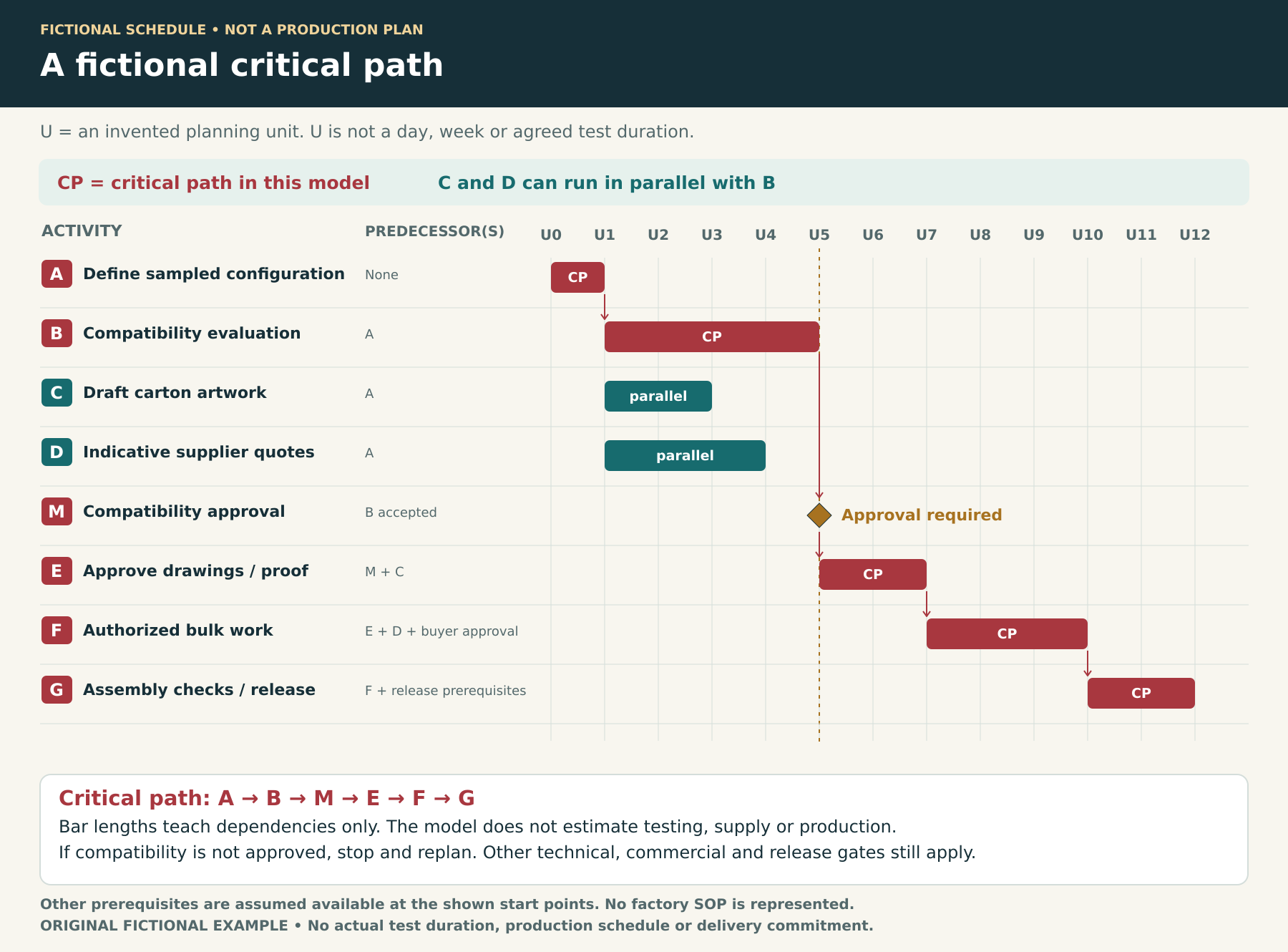
- A. Define sampled configuration: U0–U1; no predecessor.
- B. Compatibility evaluation: U1–U5; waits for A.
- C. Draft carton artwork: U1–U3; waits for A. Can run in parallel with B.
- D. Indicative supplier quotes: U1–U4; waits for A. Can run in parallel with B.
- M. Compatibility approval: a milestone at U5 in this invented example; requires B to be accepted. If compatibility is not approved, stop and replan.
- E. Approve drawings / proof: U5–U7; waits for M and C.
- F. Authorized bulk work: U7–U10; waits for E, D and buyer approval.
- G. Assembly checks / release: U10–U12; waits for F and the applicable release prerequisites.
The model’s critical path is A → B → M → E → F → G. C has two arbitrary units of total float and D has three under the modeled assumptions. Other technical, commercial and release prerequisites are assumed available at the shown start points. No actual factory SOP, customer job, delivery promise, test duration or production schedule is represented. A real project requires agreed tasks, durations, owners, acceptance criteria and dependencies.
In this simplified network, artwork preparation and indicative quotes can progress while compatibility work is underway. Final drawings and proof approval wait for the compatibility approval milestone and the artwork draft; bulk work also waits for buyer approval. If compatibility is not approved, stop and replan. Actual owners, durations, technical approvals, commercial commitments and release conditions must be agreed for the real project.
| Gate / activity | Can run in parallel | Must wait for |
|---|---|---|
| Brief and supplier quotes | Concept artwork and component research | Confirmed scope before commercial commitments |
| Formula/package samples | Draft carton artwork | Actual configuration before compatibility sign-off |
| Final drawings and artwork | Approved marketing preparation | Fit, label review and required technical approvals |
| Bulk purchasing / production | Only approved workstreams | Purchase approval; unresolved-risk decision; release prerequisites |
| Packing / shipment | Shipping preparation | Batch release, complete-pack validation and route acceptance |
Talk to our team about packaging options that align with your MOQ and launch timeline.