
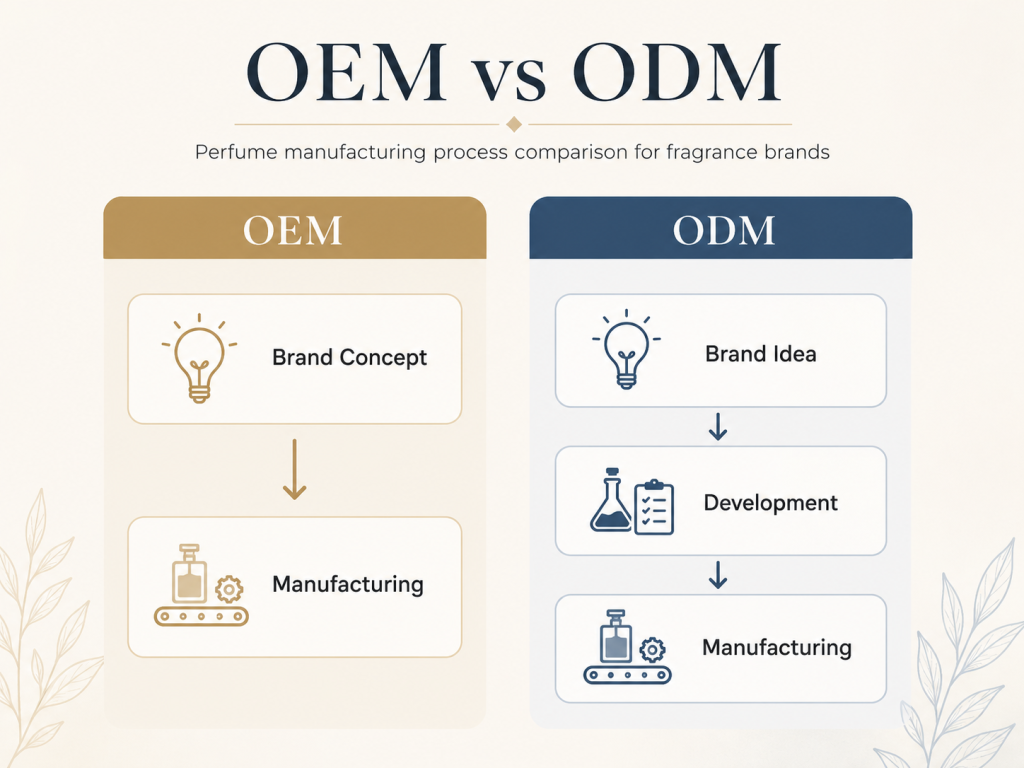
This is the detailed OEM/ODM task-allocation guide. Use it to agree who supplies inputs, develops, reviews changes and releases the product. For the broader terminology comparison including private label, see private label versus OEM versus ODM.
Some brands already have a clear product concept, fragrance direction,
and packaging requirements. Others have a brand idea but need support
with fragrance development, product planning, and manufacturing
solutions.
Define the development and production support your project needs, then discuss the scope through perfume OEM ODM services. The model name does not establish formula ownership, exclusivity, cost or a delivery date.
1. What Is OEM Perfume Manufacturing?
For this comparison, OEM describes a proposed production route based on customer-supplied specifications, authorized formula information or materials. Confirm the actual inputs; a scent direction alone is not necessarily a manufacturing formula.
An OEM proposal may include these agreed execution tasks:
- Formula production
- Filling and assembly
- Packaging production
- Quality inspection
- Documentation support
Inputs that can support an OEM scope review:
- Authorized formula/material information
- Defined product and packaging requirements
- Named technical and commercial decision owners
2. What Is ODM Perfume Manufacturing?
For this comparison, ODM includes supplier involvement in development as well as a proposed production scope. Confirm who performs each task, including any partners.
ODM support may include:
- Fragrance direction development
- Product concept suggestions
- Formula development support
- Packaging recommendations
- Manufacturing solutions
Reasons to request an ODM scope review:
- Need for development from a brief
- Open formula or packaging choices
- Need to define technical deliverables and approval responsibilities
3. OEM vs ODM Perfume Manufacturing Comparison
| Work / rights topic | Customer responsibility to agree | Manufacturer / partner responsibility to agree | Release evidence |
|---|---|---|---|
| Brief and supplied inputs | Requirements, references, authorized files/materials | Feasibility and missing-input review | [Accepted scope and version] |
| Formula development | Decision owner and evaluation criteria | Named developer, variants and technical assessment | [Identified sample and formula approval] |
| Pack and artwork | Brand content and market inputs | Drawings, samples and compatibility/assembly review | [Approved component/artwork IDs] |
| Formula rights and exclusivity | Required use, territory/channel/term and transfer needs | Existing rights, proposed license/assignment and limitations | [Signed applicable clauses and deliverables] |
| Changes | Approve commercial/brand impact through agreed authority | Assess material/process/safety/label implications before execution | [Change request, evidence, decision and date] |
| Production and release | Agreed acceptance and recipient responsibilities | Batch records, required tests and authorized disposition | [Release authority and record] |
4. Key Differences Between OEM and ODM
The working distinction is the agreed development responsibility. Neither route automatically removes the brand’s decisions or assigns every technical duty to one party.
OEM can be considered when the customer has usable, authorized inputs and the manufacturer accepts them.
ODM can be considered when supplier development support is needed and its scope is accepted.
A fragrance manufacturer may support ODM projects through:
- Market positioning discussion
- Fragrance direction selection
- Sample development
- Packaging suggestions
- Production planning
5. How OEM Perfume Development Works
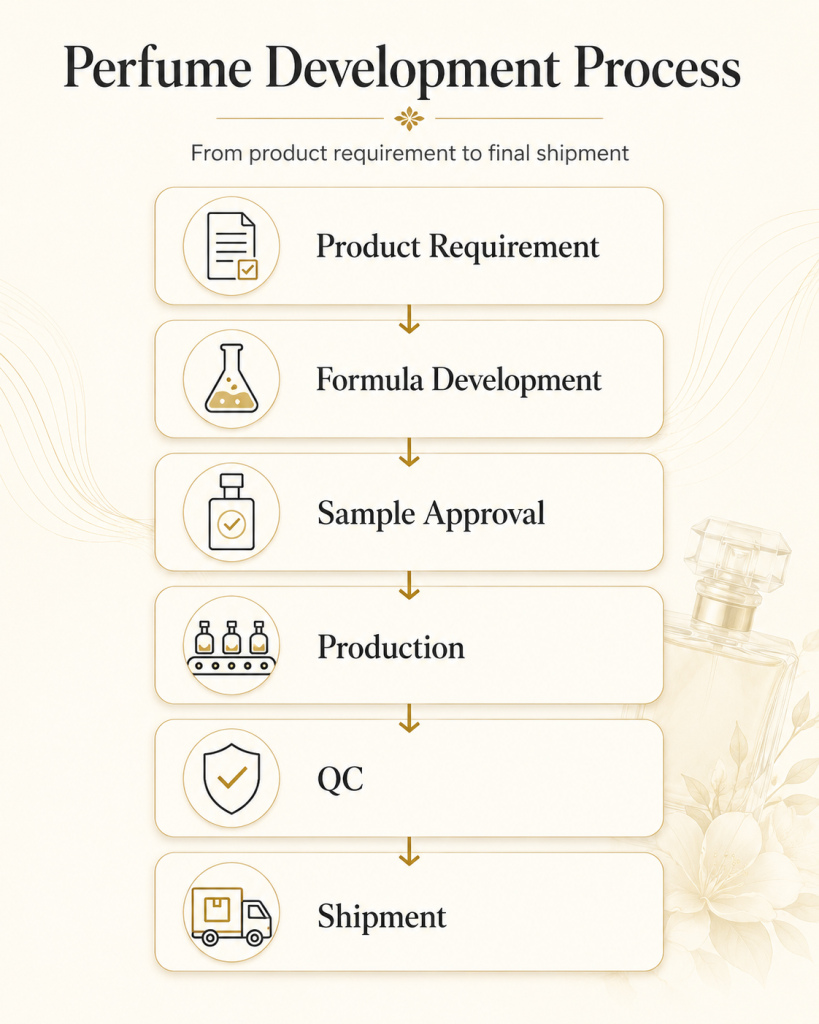
Example OEM task sequence, subject to the actual scope:
- Product requirements confirmation
- Fragrance specification review
- Assess supplied formula and any agreed changes
- Sample approval
- Packaging confirmation
- Bulk production
- Quality inspection
Use the fragrance manufacturing process to identify the records and gates that connect development, packaging and production.
6. How ODM Perfume Development Works
Example ODM task sequence, subject to the actual scope:
- Brand idea discussion
- Market positioning
- Fragrance direction development
- Sample creation
- Packaging recommendation
- Product confirmation
- Manufacturing
7. Advantages and Challenges of OEM
Advantages
- Defined specification and change-control scope
- Use of authorized customer-supplied inputs where accepted
- Recorded production responsibilities
Challenges
Confirm who supplies each material/file, which inputs are missing and how they will be qualified. Customer experience alone does not establish route readiness.
8. Advantages and Challenges of ODM
Advantages
- Agreed development support from a brief
- Help assessing open product choices where offered
- Defined deliverables and review responsibilities
Challenges
The brand still needs decision owners and a brief. Development support does not guarantee a faster route, lower cost or an exclusive formula.
9. Which Option Is Better For New Fragrance Brands?
There is no universal answer. The right choice depends on your
experience, product vision, and development requirements.
Choose the scope from actual inputs and support needs:
| Current situation | Route question | Required confirmation |
|---|---|---|
| Authorized formula/materials and specifications available | Can the factory accept an OEM execution scope? | Input rights, technical completeness and process/evidence review |
| Creative brief but key technical choices open | What ODM development support is available? | Team, deliverables, sample/approval plan and quote |
| Mixed inputs or different sites | Can responsibilities be combined in a hybrid route? | Interfaces, transfer permission and release authority |
| First-time brand | Which tasks can the buyer perform and which need support? | Experience label alone does not decide the route |
10. Which Option Is Suitable For Your Project?
Choosing between OEM and ODM depends on how much support your fragrance
project requires.
OEM scope questions:
- Are the supplied specifications and inputs usable and authorized?
- Who handles target-market review?
- Who reviews process or material changes?
ODM scope questions:
- Which development deliverables are required?
- Who evaluates and approves sample changes?
- Which packaging and technical support is actually included?
In real fragrance projects, OEM and ODM are not always completely
separate. Many brands combine both approaches depending on their
business stage and development needs.
Use the factory capability information to prepare evidence questions about the proposed site and process. Confirm the actual route and available support.
Discuss your fragrance project with known inputs, open decisions and the responsibility matrix. Ask for a defined proposal rather than relying on the model name.
FAQ
What is the difference between OEM and ODM perfume manufacturing?
In this working comparison, OEM emphasizes execution from accepted customer inputs; ODM includes agreed development support. The proposal and agreement must define the actual division of work.
Is ODM better than OEM for new perfume brands?
It depends on the tasks and support needed, not simply whether the brand is new. Compare actual scope, cost, evidence and decision ownership.
Can a perfume manufacturer create a custom fragrance formula?
Ask the proposed manufacturer which development resources and partner services are available for the brief. Confirm deliverables, rights, evaluation and production feasibility; no universal in-house capability is assumed.
Project Review Responsibilities
This guide does not establish that an identified expert has reviewed a specific formula or manufacturing route.
Record the actual qualified technical, market and commercial reviewers and the scope/date of their approval in the project files.
Responsibilities to assign:
- Private label fragrance development
- OEM/ODM perfume manufacturing
- Product development and quality control